For our last discussion group of the year, on 18 December 2023, we chose a somewhat lighter and more humorous book in Graham Linehan’s Tough Crowd: How I Made and Lost a Career in Comedy.
Somewhat lighter in the sense that the first half or ⅔ of the book focus mainly on Linehan’s career in comedy up until the chapter called ‘Interlude‘. We all had a different level of familiarity of Linehan’s work up to him becoming an outspoken activist, so the first part of the book specifically appealed to us in varying degree and on different levels. Some of us were not that interested or enthralled due to a lack of interest in his comedy career or not liking his style of comedy whilst others found it made them want to watch / rewatch his best loved series like ‘Father Ted ‘ and ‘The IT Crowd ‘.
Phil, who had the audio book of Tough Crowd, felt that this was very poignant and added a lot of humour to the book as it was read by Linehan himself. Listening to Linehan speak his own words added an extra dimension to the book and really highlighted how things have not been great for Linehan in the last 5–6 years. Phil also informed us that the original intention had been to publish two books, with the first one focussing on Linehan’s comedy career and the second his cancellation.
Björn continued the discussion by noting how Linehan, when speaking of people he admired or had influenced him, spoke about men the vast majority of the time. He mentioned directors such as Scorsese, Tarantino aand when speaking of TV series and comedy spoke mainly about male comedians (Jerry Seinfeld, Steve Coogan) or male characters portrayed in shows. The absence of female artists and comedians really stood out in comparison to feminist books and books by women and it was a surprise that women like Dawn French and Jennifer Saunders, series like Absolutely Fabulous or writers like Nora Ephron did not get name-checked (though Linehan did mention When Harry met Sally, which Ephron wrote). This was not a criticism of Linehan personally. In our discussion we concluded that this reflected very much the patriarchal world we live in where the majority of work is by men and men are revered, whilst women are forgotten. Phil felt that Linehan has changed quite a lot over the last 6 years in terms of his place in the world and who he spends time with, so what he picked out may have been more of a reflection of who he was then, rather than who he was now. Phil recognised something of his own process in this: reading more work by women, immersing himself more into feminist theory etc.
“…we now had children who had been born in the wrong body, their true selves only blossoming into existence over the jagged lines of a fresh double mastectomy.”
Graham Linehan – Tough Crowd (p. 266)
We then spoke briefly about Linehan’s surprise, which he came back to a few times in the book, that nobody followed him as he ‘rode into battle’ (as he put it) against gender ideology. It really seemed like Linehan believed people would agree with him and was blindsided when they didn’t. What seemed perhaps more surprising to him than nobody expressing their agreement with his points of view, was that nobody even seemed to defend his humanity or decency. Not once it seemed did anyone stand up and say: “You know Graham is a reasonable and thoughtful guy. He’s not evil by any means, so maybe he is seeing something that we’ve overlooked and we should give some thought to what he has said.“.
In terms of the appeal of the book, opinions were a little divided. Where it made Björn want to watch The IT Crowd, Robbie didn’t feel the parts of the book focussing on Linehan’s comedic career were very appealing. Whilst Robbie could see the relevance of providing background information, he felt this part could have been condensed more and much preferred last third of the book with its focus on Gamergate and gender ideology.
There was definitely a sense that the book worked better as a standalone rather than it being divided into two books. In combining the two stories both parts of Linehan’s life received attention and this means that it appealed to two groups of people who could both enjoy some or all of it. It also means that there is added context from the real of comedy and things you can no longer make fun of, which translates quite nicely to points of view you can no longer hold in certain situations or among certain groups of people.
Chris felt similarly to Robbie in that there were parts of the book he did not like and particularly picked up on the use of the term ‘TERF’ in the Interlude section of the book. Chris felt that self-describing as a ‘TERF’ creates the risk of giving people ammunition by posing us as ‘the enemy’, when all we are doing is trying to protect women’s rights, child safety etcetera. Chris felt that there is a particular difficulty with appropriating the term ‘TERF’ publicly (e.g. in books or on social media) and felt that it is important to tread carefully in public with things like that. An effort has to be made in certain public spaces, for instance in court rooms or other forums, to make sure that people understand that it is a slur used by (mainly) men towards women.
From this point onwards the discussion took a somewhat different term and we started discussing which term has our preference. Robbie quite liked the term ‘gender critical’, whilst Phil and David spoke about ‘gender atheism’, which does have quite a ring to it. We then spoke about the fact that if the term ‘gender questioning’ was not already taken, this would make quite a good candidate.
David felt that there was a real dislike for the term ‘gender critical’ in certain circles, and that the group as such seems to be seen as bigots by some opponents. ‘TERFs’ meanwhile are quite often seen as women who are ‘not really’ feminists as they do not include trans-identifying men in their definition of ‘woman’.
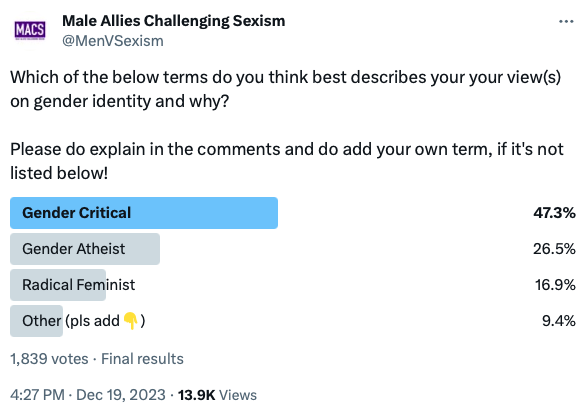
As a result of the latter part of our discussion, we decided to create a Twitter poll to see which terms people preferred. You can find the poll here.
Below you can find a screenshot of the results. It bears noting that many people who chose ‘other’ described themselves as a ‘realist’ (incl. sex realist, biological realist etc) and a significant proportion of women described themselves as radical feminists.