Introduction
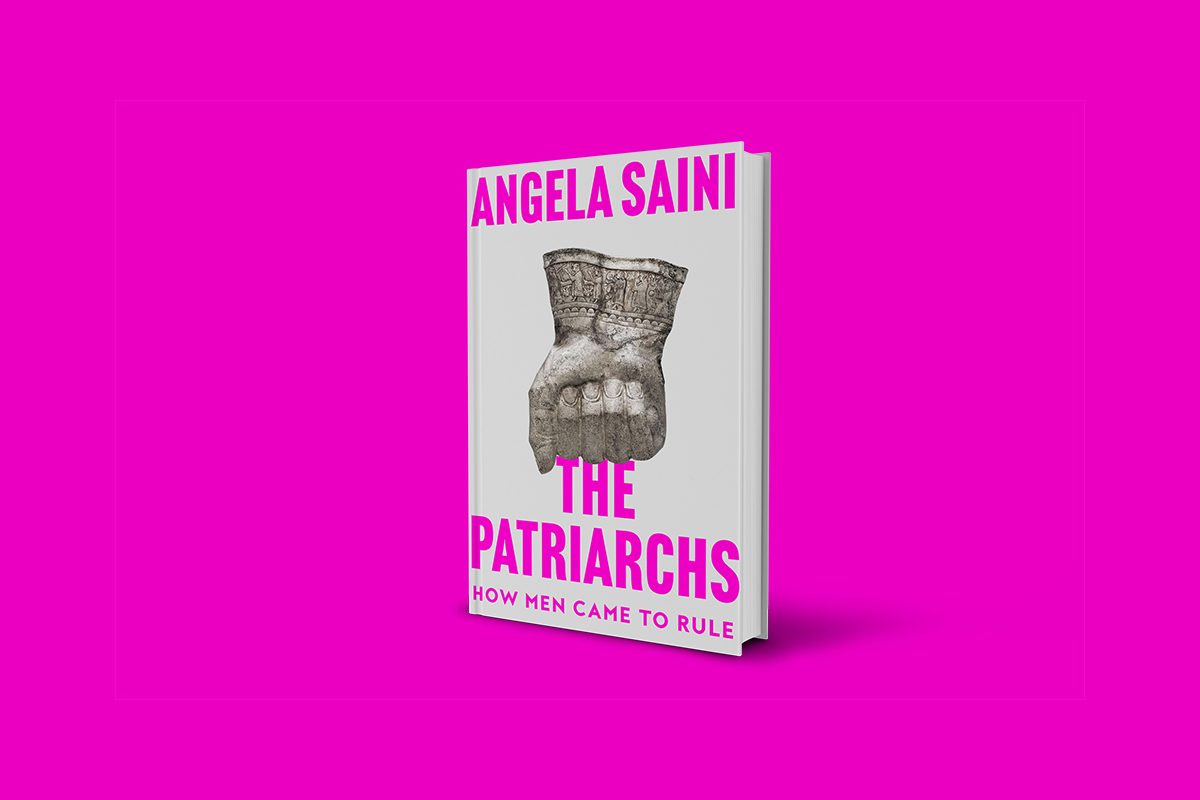
Due to various constraints we were unable to notes of our meetings in February and March 2024 (a 2-part discussion on Sharron Davies’ Unfair Play: The Battle for Women’s Sports) and a YouTube video of James Hillman lectures titled Pink Madness: Why does Aphrodite drive us crazy with pornography?.The MACS discussion group has been around almost as long as MACS. Our original aim was to select a book on feminist-related issues once a month and share our responses to it. Over time we found the same issue all book groups have, of people not finding time to finish (or even start) the book so recently we diversified by choosing short videos or articles; either as an alternative way to get familiar with an author’s ideas or because of their intrinsic interest. So the meeting in June 2024 was dedicated to Angela Saini’s book The Patriarch’s: How Men Came to Rule, but we chose an audio interview with the author hosted by the Now and Men podcast as the basis for our discussion.
Angela Saini and the Origins of Patriarchy
Saini defines patriarchy, not as all males dominating all females but as a way for an elite class of males to dominate women and most men – an important point to bear in mind in all discussions of the subject. In her book The Patriarchs, Saini is mainly concerned with the origins of patriarchy and questions some familiar assumptions surrounding it. For example the notion that male domination does not seem to be an inevitable result of (e.g.) greater male strength, as we have examples from the primate world of females cooperating to achieve domination over the stronger males (this is the case with bonobos, the closest living relatives to humans). She also targets a well-worn theory that the move to patriarchy came with the transition from hunter-gatherer societies to agriculture. She claims that this transition (usually dated to around 10,000 years ago) came long before we see any evidence of what she calls ‘gender depression‘. A more likely turning point, coming 1000s of years later, was the emergence of the first states, as these prioritised the role of women in producing male children, who would then be raised as warriors and agents of imperialism. Saini also talks about how patriarchy has been reinforced by interpretations of history and prehistory. When the anthropologist Marija Gimbutas pioneered the idea that early societies were Goddess-worshipping matriarchies she was heavily criticised, but some aspects have been supported more recently by DNA evidence and her ideas have become fashionable again. Furthermore Saini questions the emphasis given to ancient Athens as a model for civilisation, despite the fact that Athenian society was “weirdly misogynistic” and there were other societies from antiquity that could have offered a better model in terms of equality between the sexes. Saini is keen to emphasise that patriarchy is not inevitable, but an artificial construct that has had to be reinvented in diverse forms, from ancient Babylonia down to Putin’s Russia and Afghanistan under the Taliban. Her evidence for this was the main point of contention in the discussion we had. She points to the existence of matrilineal societies in existence currently (over 160 have been identified by anthropologists), that are all structured in a different way. This contrasts with patriarchy, which tends to be quite uniform, partly because it has often been imposed on indigenous societies by colonial powers. The problem here is that matrilineal societies are not the same as matriarchal ones, let alone the kind of society feminists would like to achieve. As Ivan Jablonka says in his book A History of Masculinity: From Patriarchy to Gender Justice (which we’ll be discussing in November) “There is no known society in which women as a group exercise the entire range of moral, political and economic power …by codifying social life … or making the decisions that involve the whole community.”