TALK – OUT OF THE DARKNESS: GREENHAM VOICES

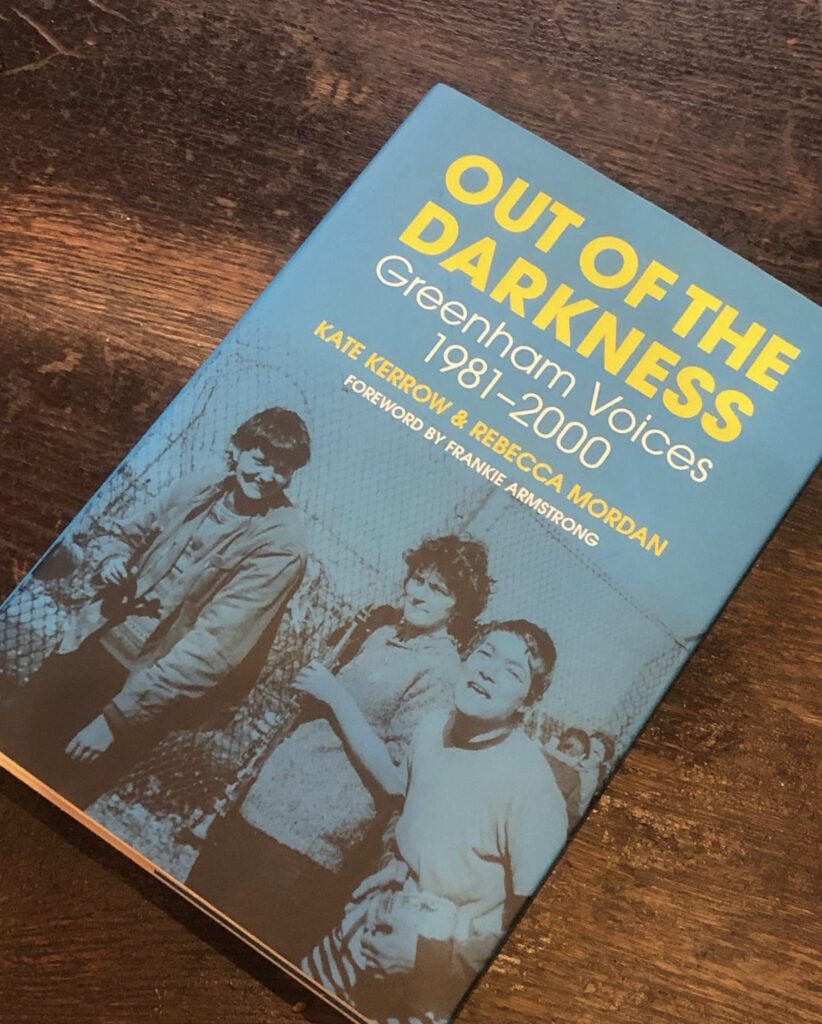
On 5 March Björn went to Leeds Lit Fest for a talk by Rebecca Mordan about the book, ‘Out of the Darkness: Greenham Voices 1981-2000’, which she co-authored with Kate Kerrow.
Mordan sang Greenham Women’s songs, her collaborator Shazz read out some personal testimonies featured in the book and we heard from 2 women who had lived at Greenham Common about their reasons for going and their experiences at the camp.
One of the women explained that she was expected to be a nurse, “one of 3” career options that her father and indeed society expected were suitable for her alongside becoming a teacher or a secretary. She also spoke about the pressure she felt to be heterosexual and the difficulties she would have experienced if she had not gone to Greenham, where she could explore who she was and was accepted for who she was. It felt important to be reminded, how liberating the camp was for a lot of the women, who were shackled by the the expectations of the patriarchy and the men in their lives.
It was interesting to learn from Mordan, who had visited Greenham Common multiple times as a child and adult, that Greenham gradually became a women-only camp. The reason for this was that the men weren’t pulling their weight or contributing in a communal way. Mordan explained that the men seemed more interested in maintaining gender-roles, e.g. wanting to wield walkie-talkies instead of doing dishes, whilst the women who were at Greenham wanted to leave these sexist expectations behind them. They had not left their homes and families behind, just to be cleaning up after the men again!
The talk was absolutely brilliant – in equal measures funny, inspiring and infuriating.
Please do check out the Greenham Women Everywhere Archive Project.
‘ON THE MEANING OF SEX’ ONLINE BOOK LAUCH – IWD
On International Women’s Day Björn attended the online book launch for Kajsa Ekis Ekman’s new book ‘On the Meaning of Sex’ published by Spinifex Press. You can find our review for the event here. It was an absolutely amazing event, providing a lot of thoughtful discussions and insights, not just of how we got to where we are, but also about what the situation is like in countries outside of the UK.
We highly recommend that you watch the event online here!
LONDON WOW FESTIVAL – FIRDAY 10 MARCH
8, 7 and even 6 years ago the annual WOW Festival festival attracted large swathes of women and some men at London’s Southbank Centre. I went a few times, mainly because I wanted to see a particular speaker during the day or attend a specific evening event. The concert by legendary Angélique Kidjo and the amazing Fatoumata Diawara in 2013 particularly stands out in terms of surrounding events.
Despite its issues, WOW has many things going for it, they attract brilliant and inspirational women from all over the world, but in the end I stopped going due to the liberal and aspirational / ‘can-do’ atmosphere, which I felt watered down the messaging. This change of direction from WOW also means that feminists like Julie Bindel who spoke at WOW 10 years ago, are no longer taking part in the event. I am also certain that the programming of a rapist and the woman he attacked has left lasting scars on the festival in terms of attendance and support. The event was later removed from the WOW programme, but still took place at the Southbank.
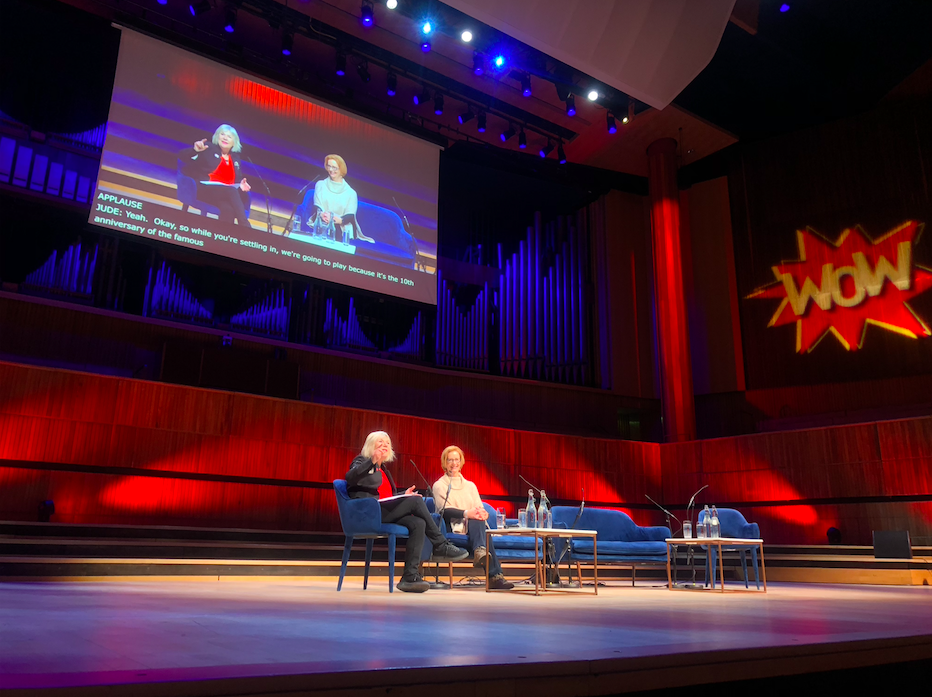
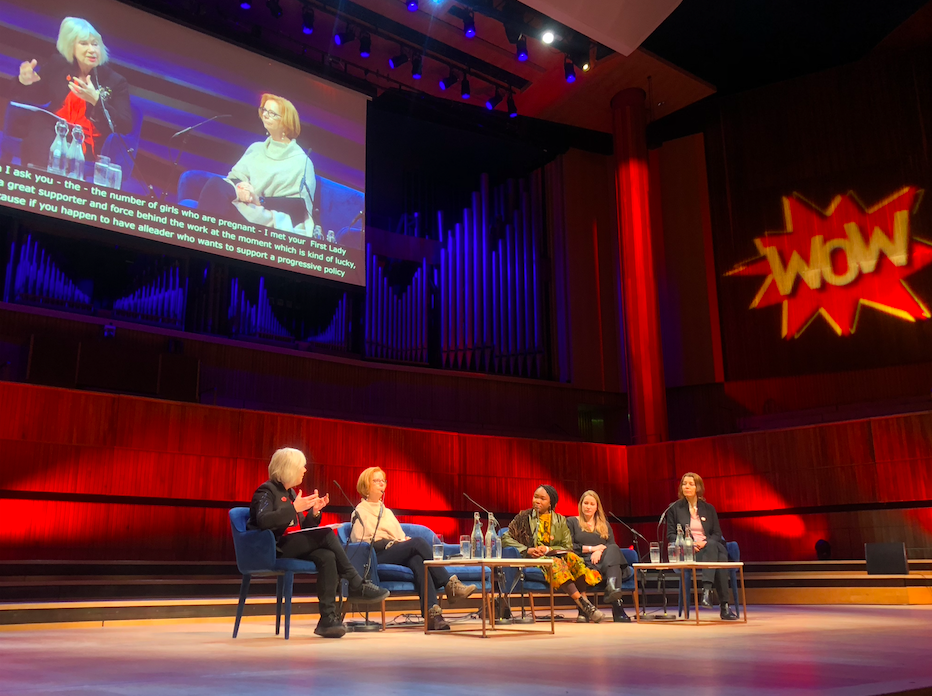
Day tickets this year were half price, perhaps a sign of a struggling festival? As tickets were so cheap and there were a couple of worthwhile events on the Friday, a friend and I decided to go decided to go. I decided to leave my radical pro-feminist hat at home and learn and be inspired as much as possible. As usual, the festival’s founder Jude Kelly, chaired the opening session ’Women, Power & Misogyny’, which also featured Elif Shafak, Julia Gillard, Josephine Kamara and Laura Bates. When we walked into the main auditorium, I was actually surprised at how few people were there.
After an impassioned keynote address by Verna Eggleston, Julia Gillard, Australia’s first female prime-minister, took to the stage. When asked by Kelly about misogyny, Gillard said that her famous ‘misogyny speech’, which celebrated its 10th anniversary in 2022, focussed on misogyny as there seemed to be this idea that any man who says “I love my mum” once, is therefore not a misogynist. Gillard said that she wanted to address issues and events beyond the daily occurring sexism and address the endemic sexism that is prevalent in society. In relation to this, Gillard referred to the recent swathe of revelations surrounding misconduct of male police officers in the UK police forces.
Speaking about hoe things have changed since she gave her speech 10 years ago, Gillard said that she felt that the public discourse had improved in terms of sexism and misogyny, but that the social media discourse has gotten much worse. She felt that media coverage of women in politics had gotten better, though Jude Kelly appeared to disagree, mentioning the media coverage following Theresa May’s coughing fit in 2017.
I really respected that Gillard highlighted the fact there is ‘strength in the breadth’ of the feminist / women’s movement and that this is something that should be celebrated. In other words, it takes a range of activist styles from those chaining themselves to railings (like the suffragettes), organising rallies and protests, to those talking to people in pubs and in their homes about equality and women’s rights.
After about 10 minutes, Kelly and Gillard were joined by Elif Şafak, Josephine Kamara and Laura Bates. Josephine Kamara. Kamara spoke about her work through her organisation Women of Wonders Sierra Leone which is working to help girls who have gotten pregnant in Sierra Leone stay in school. Kamara spoke about how during Ebola outbreak in 2014, when everyone was isolating 14,000 girls fell pregnant, many of whom were raped and had to live with their abusers. Because pregnant girls are banned from school this meant that these girls could to finish their education. Kamara and other girls in Sierra Leone have worked tirelessly to change this situation and helped overturn the law to finally allow girls to continue to go to school and do their exams.
Gillard spoke about recent research results from the Global Institute for Women’s Leadership, which she founded, found that younger people are more likely to feel that feminism has gone too far and that younger people are more likely to think that a man who stays at home to look after children is less of a man. These are unsettling findings indeed and it would be interesting to know more about what underlies these attitudes. A lot of it can probably explained by the fact that men do not want to share their privilege and power, like spoilt children who are not happy to share their toys but I also wonder what impact we have with how we communicate about men’s violence, for instance the phrase ‘toxic masculinity’, which I can imagine makes some boys and men feel like violent and abusive behaviour is part of how we are seen and what it means to be a man.
The brilliant Laura Bates spoke next, passionately and angrily, about the crisis we are currently facing not just in politics but also in public health. She highlighted the awful fact that 1 in 3 girls say that they have been sexually assaulted at school, a place in which they are supposed to learn. At the same time 56 current UK MPs have been accused of misconduct, but the government is not investigating this. Add to that the fact that 2000 police officers have been reported for sexual misconduct over 4 years and you can see that there is structurally something wrong. These are not just ‘a few bad apples’ as Bates pointed out. It goes all the way into the root and the surrounding soil!
Elif Şafak spoke next and spoke about the current situation in Iran, where hundreds of Iranian schoolgirls have been hospitalised following chemical attacks and the government feigning ignorance, highlighting the fact that the patriarchy is not only strong, but also ruthless in its oppression of women and girls.
The opening session of WOW was very powerful in my opinion and I was especially moved by Bates’ and Şafak’s contribution, which highlighted the absolutely disgraceful situation we are in at the moment. All the suffering that women are going through in the world, be it Sierra Leone, Iran or the UK are systemic human rights abuses and they are just not being treated as such. The murder of women is not terrorism, the conversion of young boys into misogynists is not grooming and misogynist culture is not extremism. It is ‘just normality’.
I also attended the session ‘Women and Madness: Power Abuses and our Emotional Worlds’. The session featured poet, liberation and Community Psychologist, writer and presenter Dr Sanah Ahsan; Consultant Clinical Psychologist and campaigner Dr Lucy Johnstone; activist and writer specialising in trauma, abuse and recovery Jacqui Dillon; and Consultant Clinical Psychologist & Mindfulness Practitioner Dr Jasmine Chin.
This session was really insightful and highlighted how women’s understandable reactions to male abuse have historically been pathologised. One of the survivors brought this into firm focus when she said that the things that her abusers had said to her, were then later said to her by psychiatrists.
The session also highlighted the additional prejudice black women experience, whose reactions to male inflicted trauma are more likely to be seen as ‘bad’ and criminalised. The point was made that black women can almost count themselves lucky to be seen as ‘mad’ rather than ‘bad’.
The panel then talked about how the system of patriarchy is reinforcing a certain kind of knowledge, which does not include knowledge of the body. Also, when looking at the bulk of what is happening to women at the hands of men, there is a tendency to individualise women’s ‘problems’ rather than tackling the patriarchal structure.
Sanah Asan then spoke about the trend that more and more girls self-diagnosing through TikTok and the understandable sense of relief through recognition that this can provide. She did however also point out the this trend is problematic, as social media aren’t neutral and much more insidious than for instance magazines due to the fact that the content is targeted – i.e. you are presented with / suggested more and more content that is similar / the same than what you are looking at.
With regards to expectation on women, the panel questioned how women can possibly express rage, when there isn’t place for it in society, especially for black women and pointed out that currently, depression is being understood as rage turned inwards. At this point in time 1 in 5 women are on anti-depressants and the panel asked a poignant question “What does this tell us about the anger of women?“.
The last event I attended was ‘The Power‘, a panel discussion about the upcoming release of the TV adaptation of the bestseller of the same name. The panel featured the novelist Naomi Alderman, series producer Jane Featherstone and actress Heather Agyepong and was chaired by journalist and broadcaster Jane Mulkerrins. The event was a really interesting insight into the production and development of the series as well as the creation of the book.
PETITIONING & OTHER SUPPORT
We signed a petition to the Justice Department of the Irish Government, Helen McEntee and Interim Justice Minister Simon Harris, asking them to implement a plan for legislation which would block any website advertising sex for sale, specifically Escort Ireland.
We also signed Emma Jane-Taylor’s petition to the UK Government asking for indecent exposure to be made an offence regardless of intent.
Following the great success of Sex Matters’ petition to clarify the Equality Act, which exceeded 100,000 signatures, we contacted our MPs asking them to get in touch with the Petition Committee and call for a debate, and to write to Kemi Badenoch and call on the government to revisit its response. You can easily do this too, using a template letter on the Sex Matters website.
We also signed a petition, asking Waterstones to remove ‘My trans teen misadventure’ by Lewis Hancock, from its prestigious Children’s Book Prize shortlist.
PRO-FEMINIST BOOK GROUP: THE RADICAL NOTION MAGAZINE – GENDER CRITICAL DISPUTES
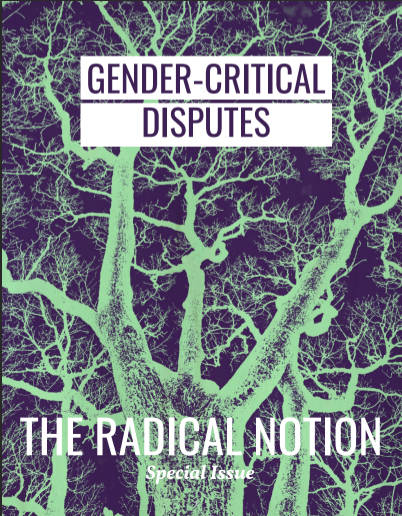
The March discussion group was held on 16 March. For this meeting we each chose to read one or more articles from the Gender Critical Disputes issue of the feminist magazine The Radical Notion. A write-up of our thoughts on the issue is available here.
Next discussion group meeting
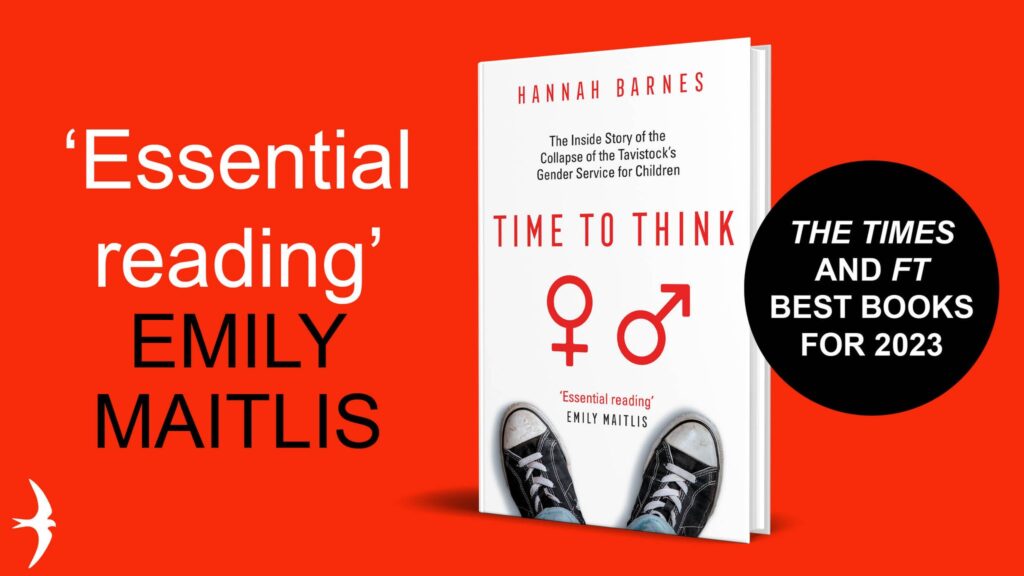
The next group will take place at the end of April / start of May. This time we will be reading Time to Think: The Inside Story of the Collapse of the Tavistock’s Gender Service for Children by Hannah Barnes.
If you would like to join our discussion group, please email us.
MEN’S DISCUSSION GROUP ON PORNOGRAPHY
We were unable to join the March meeting of the Daniel Principe’s Men’s Discussion Group unfortunately. The discussions about pornography are however continuing and the next meeting of the group takes place at the end of April. If you’re interested in attending, please DM Daniel on Twitter or contact him via his website.
LET WOMEN SPEAK – 26 MARCH
Alfie attended the Let Women Speak rally at Speakers’ Corner in solidarity and support. He also filmed the speakers, whose voices were drowned out by counter protestors. You can find Alfie’s playlist of LWS Rally on 26 March 2023 here.