

On 9 November MACS attended the Nordic Model Now Conference ‘Women for Sale: Private Matter or Public Crisis?’.
We had a stall at the event and also ran a men-only ‘Pornification Deprogramming’ workshop with Michael Conroy from Men at Work.
Sex-trade survivor Valérie Tender was the first woman to speak on the opening plenary. In her address ‘A continuum of disrespect for women as whole human beings‘, Tender explained that the nature of ‘sex work’ as some would call it, is to be sexually available, to be sexually sexually harassed and for your orifices to be penetrated. Tender said that in order to do this you need to be able to push feelings of fear, apprehension and disgust away and become dissociated.
One of the points that really stuck with me was when Tender pointed out how abhorrent it is that there are some who argue that there are ‘special’ kinds of women out there who are ‘made to do this’ and in effect celebrating dissociation from traumatic experiences as a ‘work skill’.
Tender then moved on to talking about the physical and emotional after-effects of spending a lot of time in a dissociative survival mode during her time in the sex trade as well as the grief and pain (physically and emotionally) she had to deal with after she exited the sex-trade.
Another thing that really struck me was when Tender spoke about how the sexual exploitation industries are building men with “compartmentalised empathy” and how this impacts on the women, men are in relationship with. Without having heard Tender speak about compartmentalisation Björn would later bring this up in the ‘Pornification Deprogramming’ workshop.
Valérie Tender’s honest sharing of her experiences and paradigm shift was very moving and one of the highlights of an excellent conference, I highly recommend you watch her talk at the Nordic Model Now Conference.
Tender is currently on tour and will speak in France, Switzerland and Belgium before returning to Canada. You can find out more about Tender’s speaking engagements in France and her podcast ‘La Vie en Rouge’ (in French) here.
The next speaker was Hannah Coban from Kairos in Coventry, who spoke about ‘The social media to sexual exploitation pipeline‘ from her experience working with and advocating for women who are subject to or at risk of sexual exploitation. Coban offers a wide range of services including helping them with access to safe accommodation, support groups and counselling. If you would like to learn more about the vital work that Kairos does, you can watch Hannah Coban’s talk at the conference here.
The last speaker on the opening plenary was Heli St. Luce from the Netherlands. St. Luce spoke about ‘The Nordic Model and how it differs from full decriminalisation‘. In her address St. Luce explained the history of the Nordic Model and what it means, starting with the most important aspect of the Nordic Model: the decriminalisation of prostituted women.
In het talk, St. Luce argued that this is particularly important as nobody should ever be punished for enduring exploitation and abuse. Explaining the importance of this step through a human rights perspective feels important and makes an unarguable case for the validity of the model.

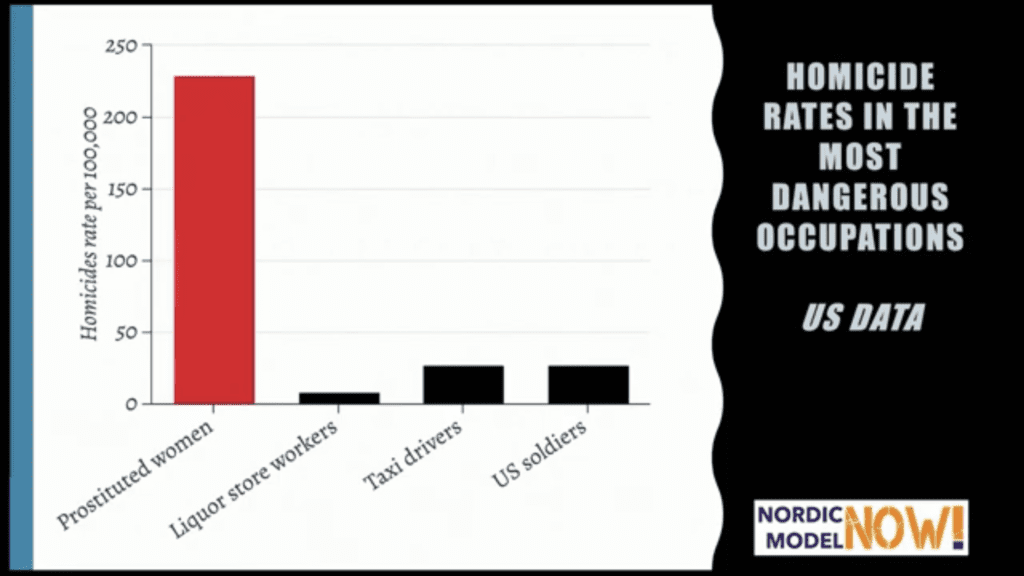
The most important fact that I took away from St. Luce’s talk is that women in prostitution are almost 10 x more likely to die than US soldiers in combat. If you would like to find out more about the Nordic Model and the effect it has had in Sweden, where it has been implemented well, you can watch Heli St. Luce’s talk at the conference here.
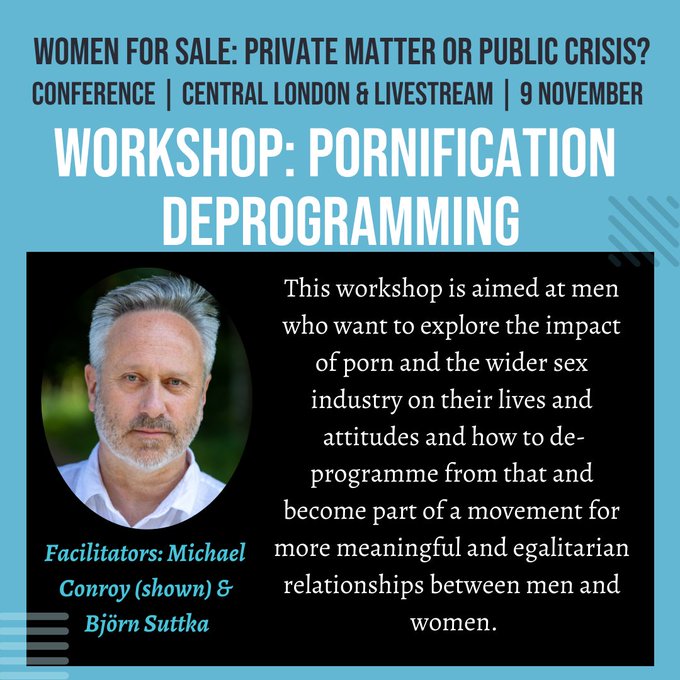
After a short break it was then time for the first round of workshops. Michael and Björn were really pleased with the attendance for their men-only ‘Pornification Deprogramming’ workshop.
Michael started the workshop by speaking about the acceleration of pornography from being relatively stable and unchanged for a long period of time to a vast expansion in terms of availability, accessibility and profitability in the last 150-200 years. From there, he moved on to discussing the impacts this has on society and how it influences the behaviour and the attitudes of the men who consume pornography, be they politicians, therapists, gamers, police or your ‘friendly’ neighbour.
The men in the room varied in age from 20–55 and we spoke about our differing pornography trajectories, from finding magazines in bushes as teenagers in the 1970s to finding it online in the mid to late 1990s and boys now watching it in public on their mobile phones and how the impact of how and where men access pornography has a big impact on their ability to interact humanely with the women in their life.
We also spoke about the social aspect of pornography use and how that may differ for men who have grown up at different times (i.e. 1980s, 1990s, 2000s etc.) and how this may also differ depending on their social circles. We spoke for instance of some groups of men openly deriding pornography as something only ‘sad losers’ do, whilst at the same time implicitly being aware that everyone was watching it to some degree, whilst other groups of boys and men openly share, watch and even bond over watching pornography.
The workshop was a great opportunity for the men in the room to explore the ways that lead us to the consumption of pornography, what sustains our engagement with pornography and ways in which we can break free from it and ‘deprogram’ ourselves from our exposure to violent pornography.
Many of the men were enthusiastic about maintaining a space to carry on with this work and we are looking forward to meeting again soon.

After the lunch break, we attended the ‘Campaigning against Surrogacy in the UK and Beyond’ workshop by Lexi from Stop Surrogacy Now and Marie-Josèphe Devillers from ICASM (International Coalition for the Abolition of Surrogate Motherhood).
The workshop seemed particularly relevant after reading Julie Bindel’s new article on surrogacy, ‘Men buying babies: The great surrogacy con’, the day before. In her article, Bindel revealed that “since 2019, as many as 95 parental orders for surrogacy in England and Wales have been issued to single men”.
Lexi spoke about surrogacy being one of the 3 different types violence perpetrated against women and girls: (1) sexism & misogyny, (2) sexual exploitation and (3) reproductive exploitation, which besides surrogacy also includes forced pregnancy, abortion and forced sterilisation.
That surrogacy is a form of violence against women was made very clear during the workshop by focussing on the mechanisms through which the surrogacy industry operates, including of course taking advantage of vulnerable and disenfranchised women and girls, often from war-torn or poorer countries.
Lexi also spoke about how the mechanisms through which surrogacy is advertised to women appeals to their altruism / willingness to help and be kind to people (Lexi referred to this as ‘toxic femininity’) and by presenting it as ‘choice’. In this context, Lexi spoke about the concept of ‘junk liberty’, which basically means that the actual choices available to women are often rubbish and thus what is being positioned as a ‘free choice’ by the surrogacy industry is actually not really a choice at all, but rather more like the choosing of a ‘lesser evil’.
I am rarely shocked, but when Lexi started talking about the concept of ‘social infertility’, I could not believe what I was hearing. If like me you have not come across this term, it describes “situations where people want to become parents but are not biologically able due to social or relational circumstances”. These circumstances include being a single man or woman or being in a same sex relationship. This concept of ‘social infertility’ is totally removed from reality and is a tool used by the surrogacy industry to further coerce women into ‘helping’ someone to have child by appealing to her altruism. As one of the women in the workshop pointed out, the use of the term infertile in this context is totally out of order, as it equates women who suffer a difficult biological fate to anyone who may find themselves in a particular social circumstance, even if they are fertile.
I strongly recommend that all men look into the important work that Stop Surrogacy Now, ICASM and also Surrogacy Concern are doing.
The surrogacy workshop really left us thinking and we spent the rest of the afternoon and evening engaged in many valuable conversations with feminists and some of the men who attended the conference.
We had some great discussions throughout the night. One of these was with Lucie from CEASE UK, who had a stall at the conference. We discussed their recent report ‘Profits Before People’ and their current campaign asking MPs to close the loophole between online and offline regulation of pornography.
As always it was great to see / catch up with friends & comrades, including Lisa-Marie and her sisters from FiLiA, Victoria, Jenny from the L Community and of course the women working for Nordic Model Now who put together this excellent event.
We’re already looking forward to the next event and hope that the conversations we had and connections we made, will lead to more activism and collaborative work in the near future!


