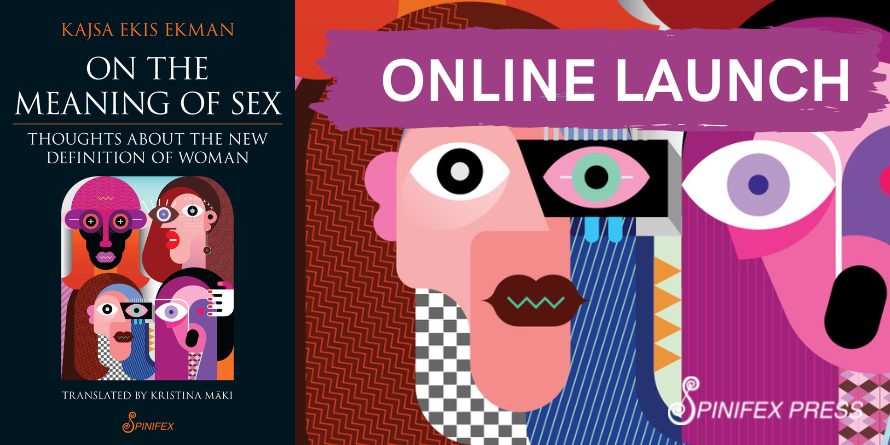
On International Women’s Day Björn attended the online book launch for Kajsa Ekis Ekman’s new book ‘On the Meaning of Sex’ published by Spinifex Press. The talk was absolutely brilliant! Not only did it provide some insight into the impact of gender identity theory in Sweden, but it also highlighted similarities between prostitution and gender identity theory, shone a light on transmen and provided some interesting insights how people in other parts of the world are experiencing what is happening in the UK. We highly recommend that you watch the event online here!
The event discussion was hosted by Bronwyn Winter, who wondered whether in future times, people will look back at our times as the “age of absurdity”. She explained that we understand history in terms of “dark and light times”, referencing the enlightenment, the renaissance etc. Winter pointed out that “some of the supposedly light times, were often among the cruellest to women”. She acknowledged that despite the fact that during these valuable ideas emerged, these ideas were “often deployed to exclude, persecute and indeed kill women, even those very women who embraced their logic to argue for women’s rights”. Winter went on to speak about our times, as being a dark dark time for women. She explained “the age of absurdity” in terms of “the summit of mount ridiculous’” where you can find the ideology of gender identity. She said that “the absurdity of today demonises women in the very name of equality, inclusion and even feminism, as well as calling us evil witches which should be burnt. Not to mention calling men women, which is sort of like saying the earth is flat really”.
Winter finished off her introduction to the event with a quote from Kajsa’s book:
“Without the word woman it is difficult for a women’s movement to exist. Without the word woman it is difficult to think and talk about women’s situation. Without the word woman it it is impossible to understand the oppression of women. Yet, removing the word woman does not rid of os women’s oppression, we will just not be able to understand it or explain it.”
Bronwyn Winter then handed over to Kajsa Ekis Ekman with two questions.
Q1: I understand that there have been some slightly more positive developments in Sweden. E.g. concerning puberty blockers in children. Could you please give us some updates?
Response from Kajsa: Some people might have been surprised how quickly Sweden latched on to gender identity theory. What many people forget is that Sweden is a very modernist country, that always wants to be the first. Sweden saw gender identity theory as modernising and Sweden needed to be brought up-to-date, like a computer programme. As a result, Sweden was very early in using puberty blockers on children, very young ones and a lot them. This however also means that the consequences were felt very early.
One of the main hospitals in Sweden, Karolinska, actually stopped using puberty blockers and the Dutch Protocol and now also the national health institutions have issued new recommendations stating that we should not use the Dutch Protocol or give hormones to children, except the ones that have already started treatment. What we do not know however, is whether local hospitals are currently (or will be) following the new recommendations.
Q2: What do you think will help us turn this dire situation around? What might help trigger a change? The news from the UK is encouraging, but it clearly has not been enough as in Australia we are incomplete denial about this.
Response from Kajsa: I have been called a transphobic and a ’TERF’ and what not and I have lost 2 jobs. Life has not been the same since the publication of this book. What i have noticed is that most people actually agree. The same people who cancel me, including politicians, journalists and intellectuals, have sent me private emails or DMs saying the they agree with me, but that they are scared to say anything publicly. It is very interesting and tells us that the problem is not having to convince people. The problem is courage. We lack courage and a lot of people don’t dare to say what they think. This will help turn the tide and a lot of other people will follow.
Kajsa said how she wanted to write the book first of all for women and the impact gender identity theory has on women. But her research she spent a lot of time with people who transitioned and found that they are the ones who are suffering the consequences of gender identity theory, more than anyone, in their bodies, because they are told that this is going to lead to happiness. Transitioners often come into this from histories of abuse, mental health problems or experiences of homophobia. They are told that it will solve their problems, but they are not told the consequences. They are not told that there is no turning back and that they will be patients for the rest of their lives. This is the reason why the book also include the effects of gender identity theory on people who transition.
Following on from this Kajsa spoke about the 3 levels in which her book analyses gender identity theory, on which it operates.
- This is about tolerance, diversity and accepting everyone for who they are – i.e. this is something akin to homosexuality and people are born like this.
- Gender is innate and biological sex is assigned at birth, which is a total turnaround in which sex has been replaced with gender. Before it was if you are a girl you mist like pink, not it is If you like pink you must be a girl. So if you like to play with dolls, you are a girl and if you like to play with cars you are a boy. If your body happens to disagree, your body is wrong and the mind is right and the body has to be changed. This is not tolerance, but an invasive and repressive idea about men and women.
- Now we are in a situation where men who commit classically male crimes, like sexual abuse, rape and downloading of child pornography, declaring that they are essentially female and should be transferred to a women’s prison. This does not match with the previous layer, where we were told that you are a woman if you like pink or ‘girly’ things. Now, a man who rapes women, who downloads child pornography, who enlisted to the military (this is an actual case from Sweden), would not by stereotypes classify as a woman. However the previous layers of gender identity theory are forgotten and he is now a woman.
Kajsa said that within transgenderism, the man decides about sex and gender. The man decides who he is and decides who women are. If he says that he is a woman, he will be treated like a woman by everyone. If the man says women are cis women, they will be treated as cis women. Kajsa thinks that the word ‘cis’ is a type of gaslighting, because the word woman has been the tool of the feminist movement for the last 200 years. Before that, it was a word that belonged to the patriarchy with men saying what a woman was, “a defect man, not a real person, has no soul, a woman is a man that went wrong in creation etc.”. In the last 200 years women have taken this word back and understood women as an oppressed class with the right to revolt. Now, patriarchy can no longer use this word as a tool, it has decided to discard the word woman as it is no longer useful for them. Having the word woman, helps feminists understand the totality of women’s oppression.
Audience Q1: Can you speak about the similarities between the prostitution system and gender ideology, which seems to go hand-in-hand and come from similar lobbying?
Kajsa said that that connection especially was how she got into this. Kajsa said how around 2014 proponents of prostitution seemed to change topic and promote gender identity theory. She wondered whether this was a coincidence and noticed that the arguments for prostitution were changing too. Beforehand the argument was that prostitution was good for women to the prostitution system needing to needs to stay for transwomen, because they can’t find any other work. When Kajsa spoke to transwomen in prostitution, she found that like most people they did not want to be in prostitution any more than anyone else did. Although this argument did not hold up, Kajsa did find that the argument was effective, as it more difficult for people to challenge prostitution. Kajsa then went on to say that there are a lot of commonalities between the sex-reassignment industry and prostitution. She particularly spoke about the the mind-body split that is required in both in terms of trying not to feel and not to be in the body. In the sex-reassignment industry, women and girls are told that their bodies, which are being objectified and exploited, are not really theirs. They are being told that they can be converted into a man. They are not told that they can not have a functioning penis and that they probably won’t be able to have children. What Kajsa thinks is so typical, is that patriarchy does not fail and this is something that she tells everyone she meets. You might think you are winning over patriarchy, but you can’t. Older heterosexual males may take hormones and change their hair, but they will not chop their penis off. The people who get maimed in this industry is young women, girls and gay boys and men as they will do ‘the whole package’.
Audience Q2: Can you say a bit more about the chapter ‘Invisible transmen’?
Kajsa said that this was one of the most painful and illuminating to write. She said that she realised that all the headlines about transpeople were about transwomen (making headlines for going into politics) and nobody actually seems to care about transmen. Transmen only get get attention when they get periods or get pregnant, which are very typical female roles and that transmen are even more invisible than women usually are. Transmen are doubly invisible as they are invisible within the wider world, feminism and the trans community. Their plight is really difficult and I am struck by this discrepancy in the debates we are having. When we talk about prisons, changing rooms and we are always talking about right of men entering female spaces, not the right of females entering male spaces. Has any woman applied to go into a male prison? Kajsa said that she has been unable to find a single one, not even an article or book about this. The only thing she could write was a piece about why nothing had been written about transmen in women’s prisons. It shows the hypocrisy of the so-called trans movement, because if it was really about transpeople, it would include transmen too. But as it has essentially turned into a men’s rights movement, we do not hear about transmen.
Audience Q3: How can we help women find the courage to speak out earlier?
Kajsa feels that the UK is really moving forward, with for instance JK Rowling, who spoke out ,despite having so much to lose. Kajsa felt that looking back, she made a mistake with the publication of her book. She just found out that everyone Kajsa acknowledged in the book have been contacted to see how they were involved in the book. In hindsight Kajsa feels she should have found public support from other women before publishing her book so she was not alone and vulnerable to be attacked by a big group of people. Let women who are being attacked know, that she is not alone and that she has support.
Bronwyn Winter added the well organised and active grassroots feminist activism in the UK, including Woman’s Place UK, FiLiA and their history of first and second wave feminist activism. Winter pointed out the critical mass of women in the UK compared to countries like Sweden and Australia and also spoke about the ‘tyranny of distance’ in Australia, being a very large country with a small population. I thought that these were some very good points and wondered whether these factors also played a part in what has happened in Sweden, also a large country with a rather small situation. The other points Winter brought up was that there is little badmouthing within feminist circles, saying for instance how FiLiA do not speak out against Kellie-Jay Keen, but get on with their feminist work. Living in the UK, it feels a lot more complicated than that. feel that is as simple as that, as there are definitely heated debates taking place in the UK about a lot of issues and women don’t get univocal support. This was highlighted later on the same day, when Jess Phillips read out the name of transwoman Brianna Ghey in parliament as part of her annual reading out of the names of UK women murdered since the previous International Women’s Day. Phillips was widely criticised for her decision to include Ghey and when Dr. Ingala Smith, a proponent of women-only spaces who tirelessly works to highlight femicide perpetrated by men, tweeted that she will not turn Jess Phillips into a target as a result, quite a few feminists disagreed with her quite openly.
Bronwyn Winter also highlighted that organisations such as FiLiA in the UK, are not single issue, but work on all issues that affect women. Winter mentioned those factors being really strong ‘assets’ and highlighted the work of individual women like Keira Bell, Maya Forstater, Suzanne Moore and Alison Bailey, who had the courage to go public on their own, but with support of the grassroots movement. Winter felt that in Australia one of the problems is that the right has appropriated the issue and it has become divisive due to a left and right polarisation. Interestingly, this echoes very much with how I feel things are in the UK as well, though it seems that Winter perceived this differently from Australia. Winter concluded that UK is a groundbreaking place, a ground zero place to see how we can turn things around.
Audience Q4: Have you noticed an increase in de-transitioners in Sweden?
There have been a couple of public detransitioners in the media, one who revealed her identity and it took a long time for her to do that as they are being attacked by their movement. What is interesting that these are also people who were very vocal about the transgender movement beforehand, lecturing at schools about this for instance. This of course looks really bad for gender identity proponents, when people jump off and speak out against it.
What is really interesting in Sweden, is that there is one clinic in Sweden that actually provides surgery for transpeople, that has opened a trauma unit for detransitioners who regret their transition and underwent medical transition at that hospital. What kind of medical care is this? Continuing to offer treatment for medical transition, whilst at the same time offering trauma treatment for the same procedure.